
Every February, like clockwork, two things happen in Canada: the RRSP deadline starts looming in every bank ad, and people start wondering whether they should be contributing to a TFSA or an RRSP instead.
It's the most-asked question in Canadian personal finance, and most answers make it sound like a personality test. Are you a "pay tax now" person or a "pay tax later" person? Do you like flexibility or discipline?
Here's the thing nobody tells you: the entire decision comes down to two numbers. Your marginal tax rate today, and your marginal tax rate when you withdraw. Everything else — every rule of thumb, every flowchart, every bank brochure — is just commentary on those two numbers.
1. The Equation That Matters
Imagine you earn $10,000 of pre-tax income and your marginal tax rate is 30% both today and in retirement. (Marginal rate = the tax on your next dollar earned, which for most of us is higher than our average rate. We'll come back to why "marginal" matters.)
Path A — the RRSP: You contribute the full $10,000 and deduct it, so no tax today. It doubles to $20,000 over the years. In retirement you withdraw it and pay 30% tax. You keep $14,000.
Path B — the TFSA: You pay 30% tax today and contribute the remaining $7,000. It doubles to $14,000. You withdraw it tax-free. You keep $14,000.
Same. Exactly the same. Multiplication commutes, and the CRA cannot beat arithmetic.
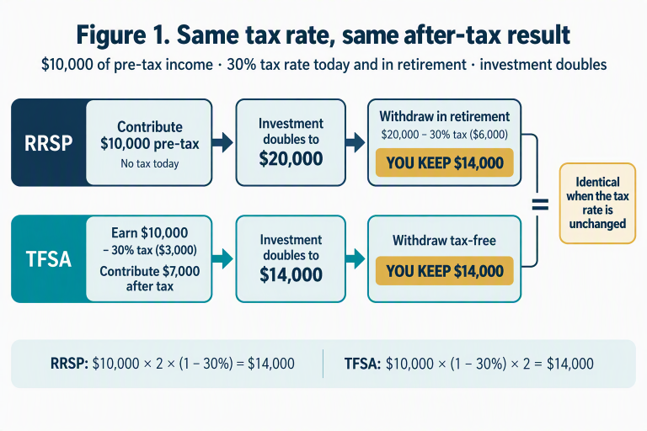
This is the single most important insight in the whole debate: if your tax rate never changed, the TFSA and RRSP would be identical. The accounts only differ because your tax rate will change — and because each account has quirks that nudge your effective rate around. So the real question was never "which account is better." It's "will my marginal rate be higher now, or later?"
2. Know What You're Dealing With
We’ve discussed the basics in Lesson 2 (TFSA) and Lesson 36 (RRSP), so here's the 60-second refresher:
The RRSP is a tax deferral machine. Contributions are deductible — put in $10,000 at a 40% marginal rate and you get roughly $4,000 back at tax time. Growth compounds untouched. Withdrawals are fully taxable as income. You can also borrow from it for a first home (Home Buyers' Plan, up to $35,000, repaid over 15 years) or for education, and you must convert it to a Registered Retirement Income Fund (RRIF), or annuity, by December 31 of the year you turn 71.
The TFSA is a tax elimination machine. Contributions buy no deduction — you fund it with after-tax dollars. But growth and withdrawals are completely tax-free, forever. Withdrawals don't count as income, which means they don't touch your Old Age Security (OAS), your Guaranteed Income Supplement (GIS), or your Canada Child Benefit.
Room mechanics — the structural difference most comparisons skip
Here's where the two accounts stop being mirror images. The TFSA gives every adult the same fixed annual room: $7,000 for 2026, unchanged since 2024. The intern and the CEO get identical TFSA room.
RRSP room scales with your earnings: 18% of last year's earned income, up to a cap of $33,810 for 2026. Earn $50,000 and you get $9,000 of new room. Earn $187,833 or more and you hit the $33,810 ceiling.
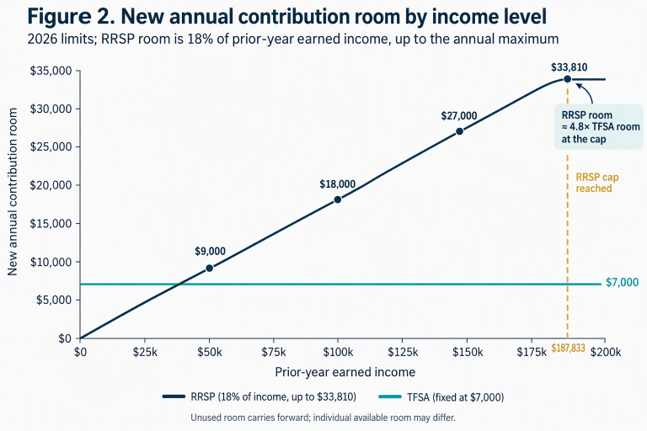
Read that chart again, because it's the most underappreciated fact in this debate: for a high earner, "max out both" isn't symmetric. Their RRSP room can be nearly five times their TFSA room. The RRSP isn't just the better account for high earners on tax-rate math — it's also by far the bigger shelter. (Both accounts let unused room carry forward indefinitely. And mind the penalties: overcontribute to a TFSA and it's 1% per month on the excess with no grace period; the RRSP at least gives you a $2,000 lifetime buffer.)
3. The Decision Framework
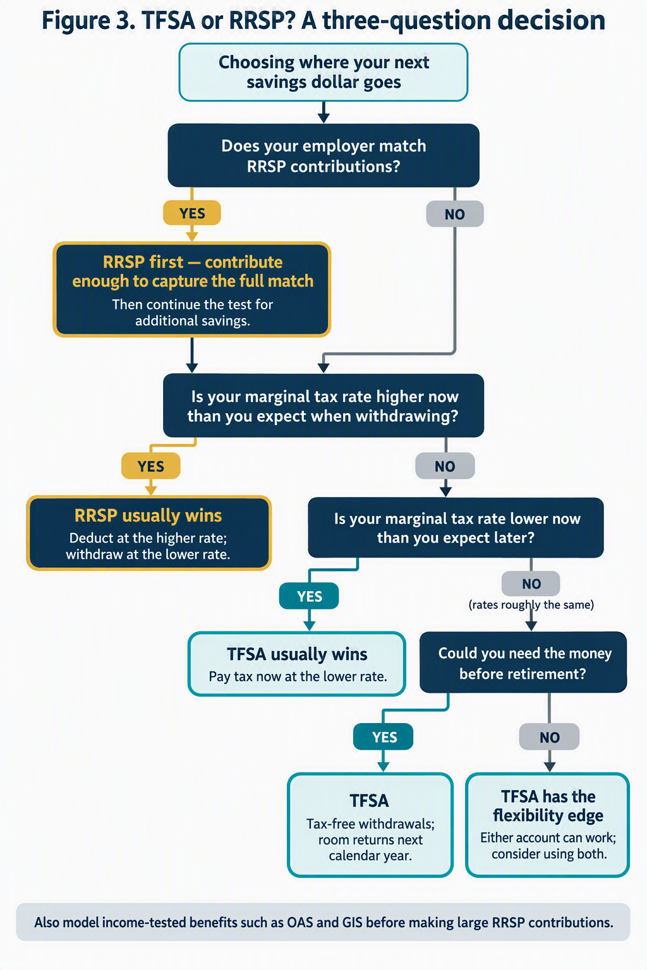
With the mechanics down, the decision is three questions:
Question 1: Is there an employer match? If your employer matches RRSP contributions, contribute enough to capture the full match before doing anything else. A 50% or 100% instant return beats any tax optimization ever devised. This isn't TFSA-vs-RRSP; it's free-money-vs-everything.
Question 2: What is your marginal tax rate now vs. anticipated rate later?
Peak earning years, expecting lower income in retirement → RRSP. You're deducting at 40%+ and withdrawing at ~30%. That's roughly an 11-cent-on-the-dollar gift from the tax system.
Low income now — student, early career, parental leave, sabbatical, gap year → TFSA. Deducting at 20% today to withdraw at 35% later is donating money to the CRA.
Expect roughly the same rate → TFSA, for the flexibility edge (more on that below).
Question 3: Do you need the money before retirement? TFSA withdrawals are tax-free and restore your room the next calendar year. RRSP withdrawals are taxable, permanently destroy the room, and can ripple into benefits. Saving for a sabbatical, a renovation, or a "maybe" house? TFSA.
4. The Wrinkles Everyone Misses
This is where the two-numbers story gets interesting, because several quirks can quietly change your effective withdrawal tax rate.
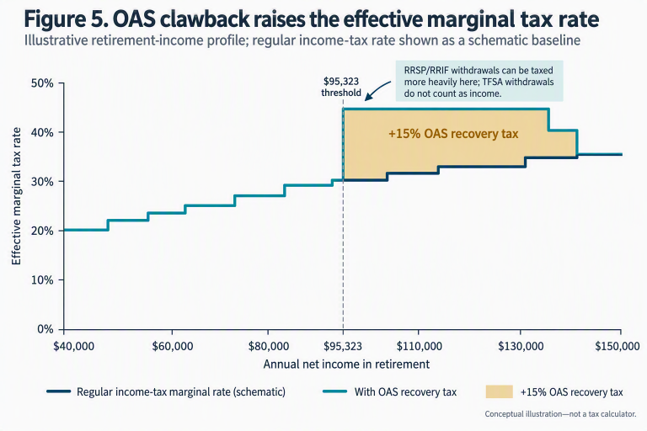
The OAS clawback: Above $95,323 of net income (2026 tax year), the government claws back your OAS at 15 cents on the dollar — on top of regular income tax. RRSP/RRIF withdrawals count toward that income; TFSA withdrawals don't. So a retiree in the clawback zone isn't facing a 30% marginal rate — they're facing 30% plus 15%. That phantom 15% has flipped many a "contribute to the RRSP" decision on its head. If your retirement income will land anywhere near six figures, model the clawback before you max the RRSP.
The GIS trap: At the other end of the income spectrum, the Guaranteed Income Supplement shrinks by roughly 50 cents for every dollar of income. For lower-income retirees, RRSP withdrawals can vaporize GIS benefits — effective marginal rates north of 50%. The TFSA, invisible to the GIS calculation, is the shield here.
Death and the deemed disposition: Die without a spousal rollover and your entire RRSP/RRIF is deemed disposed at fair market value — dumped onto your final tax return, often at the highest marginal rate of your life. A $500,000 RRIF can generate a $200,000+ tax bill for your estate. A TFSA passes to a successor holder or beneficiary with no such detonation. Morbid? Yes. Ignored in most comparisons? Also yes.
The 15% you can't get back: Hold US dividend stocks in a TFSA and the IRS withholds 15% of every dividend — unrecoverable, since there's no Canadian tax to credit it against. Hold them in an RRSP and the Canada-US treaty drops withholding to zero. This is asset location: all else equal, US dividend payers belong in the RRSP.
The flexibility asymmetry: TFSA withdrawal: tax-free, room restored next January, benefits untouched. RRSP withdrawal: fully taxable, room gone forever, and the extra income can dent income-tested credits and benefits. Optionality has value, and the TFSA has far more of it.
The RRSP meltdown (the good kind): Retire at 60 with low income? Those bridge years before CPP/OAS kick in are golden: deliberately draw down the RRSP while you're in the lowest brackets, "using up" cheap tax room instead of letting it compound into a giant, highly-taxed RRIF later. It's the rare strategy that feels wrong and works beautifully.
5. Example Scenarios
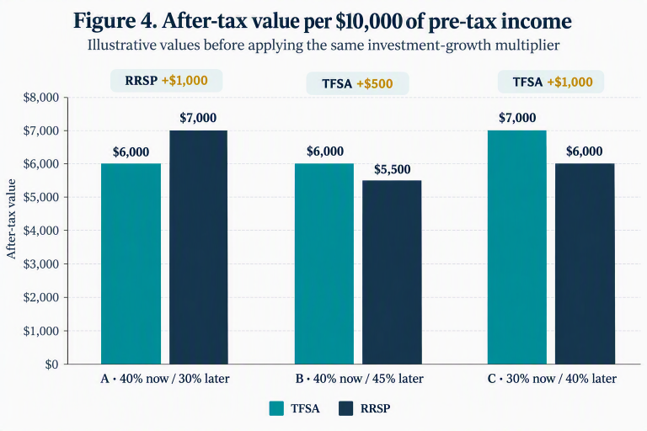
Scenario A: Maya, 35, earns $110,000. Her combined (federal & provincial) marginal rate is roughly 40%. She contributes $10,000 pre-tax to her RRSP, pocketing a ~$4,000 refund she reinvests. In retirement she withdraws at an effective ~30%. Net result: she paid tax on the money once, at 30% instead of 40% — keeping about $1,000 more per $10,000 than the TFSA route. RRSP wins, cleanly.
Scenario B: Maya again, but successful. Big RRSP, max CPP, OAS — retirement income lands at $105,000, inside the clawback zone. Her effective marginal rate is now ~30% income tax plus the 15% clawback ≈ 45%. She deducted at 40% and withdraws at 45%. The RRSP didn't just fail to help — it cost her money versus the TFSA. TFSA wins, and the clawback is why.
Scenario C: Dev, 26, earns $55,000. Marginal rate ~30%, but he's early in a career heading toward $130,000+. Contributing to the RRSP now means deducting at 30% to withdraw at 40%+ later — backwards. He fills the TFSA now, banks his RRSP room (it carries forward!), and pivots hard to the RRSP in his peak earning years. TFSA now, RRSP later — sequencing beats picking.
6. The Bottom Line
Run the three-question test: Is there a match? Rate now vs. rate later? Do I need the flexibility? That answers it for 90% of people, 90% of the time.
A few parting rules of thumb:
Under ~$80,000 of income: the TFSA wins in most scenarios. Your deduction just isn't worth much yet, and flexibility is king.
Peak earning years: shovel into the RRSP. The rate arbitrage is the closest thing to free money in the tax code (after the employer match).
At 35 with a rising income: TFSA-first is the safer default. You can always pivot to the RRSP when your marginal rate peaks — and your unused RRSP room will be waiting.
Use both. The accounts aren't rivals; they're tools. The TFSA is your flexible, tax-free pool; the RRSP is your heavy-duty, high-income shelter.
Comparing the tax efficiency of a TFSA and an RRSP can become complicated once current and future tax brackets, income-tested benefits, withdrawal timing, and estate considerations enter the picture. A qualified tax professional or financial advisor can help model your circumstances and recommend the best course of action, regardless of your age or income level.
And the biggest mistake? It's not picking the wrong account. It's contributing to neither while you spend a year deciding. The tax tail should never wag the savings dog — shelter the money first, optimize second.