
The playground can be a warzone. Kids are fighting over who cheated at hide and seek, other kids are crying at the commotion, and parent recess supervisors are crying because they had anything better to do that day. Why can’t we all just get along and play fair?
Many factors drive short term and long term market trends. Whether it’s black swan events such as the financial crisis in 2008, disagreement between supply and demand levels for particular commodities, or political risks in countries that influence GDP and sustainable economic development, it usually boils down to whether market participants are playing fairly or unfairly.
Since 2014, oil prices have decreased substantially, bottoming at sub $30 levels for the first time since the 2009 financial crisis, and then rising back and regaining some momentum up until now (November 2017). The main reasons for this stem back to economic principles of supply and demand. Booming economic times when demand for a good is high will see suppliers increasing their prices and producing more of that particular good. This in turn creates a surplus, in which there is too much of a particular commodity or product that greatly exceeds its demand. In a competitive market, suppliers will lower prices on their goods in an attempt to turnover their inventory and get rid of the excess production. In the case of oil production, until demand levels catch up with supply, downward pressure on the price of oil will occur. As the price gets cheaper, the commodity becomes more attractive over other alternative forms of energy (or substitute goods), so demand eventually starts increasing, and therefore, suppliers will produce more and increase their prices. And the cycle starts over…
But who exactly says how much oil to produce? What is considered “too much” or “too little” production? How is price and production regulated? This is where our friends at OPEC come into play.
The Organization of Petroleum Exporting Countries, or commonly known as OPEC, is an organization comprised of a number of countries who are net exporters, or in other words, produce more oil than they consume and/or import. Created in the 1960s, this organization has grown from 5 member countries to 14. These member countries include Iran, Iraq, Kuwait, Saudi Arabia, Venezuela, Qatar, Libya, UAE, Algeria, Nigeria, Ecuador, Gabon, Angola, and Equatorial Guinea today (Indonesia seems to keep getting suspended and kicked out and let back in, so let’s say 14 member countries plus or minus 1). OPEC accounts for roughly 35% of the world’s oil production, and about 55% of the globally traded production quantity. The primary objectives for OPEC are:
1) Coordinate and amalgamate petroleum policies amongst member countries
2) Ensure efficient and regular supply levels of petroleum to consuming nations
3) Ensure sufficient return on capital investment for those investing in the sector
Each member country collectively agrees on production targets and level of supply. Each member is given their own production quota. These set targets and quotas are determined and set at each OPEC meeting based on how the organization sees the global oil market and whether supply levels need to be rebalanced. Factors that influence this decision can include the current oil inventory counts, forecasted global demand, current oil prices, and national/global politics. OPEC really doesn’t change their output levels too much, with production levels ranging between 30 and 34 million barrels of oil per day between September 2015 (when oil prices began to crash) and August of 2017. It’s interesting to note the lack of relationship between OPEC production levels and the oil price trend between this time period where production levels stay relatively constant during a time of volatile energy prices.
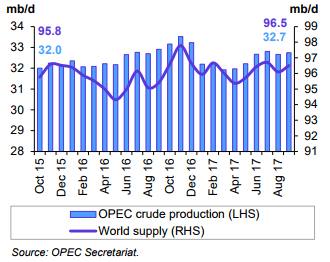
Figure 1: OPEC and World Oil Supply
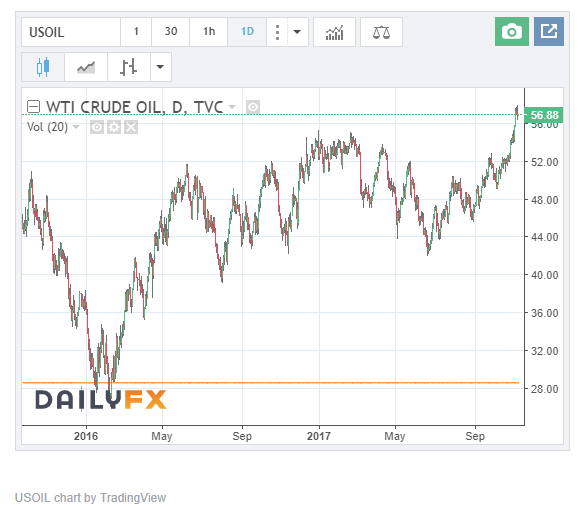
Figure 2: WTI Crude Oil Prices: Oct 2015 - Current
However, OPEC is still able to influence oil prices so effectively primarily because of its dominance in world oil reserves. Saudi Arabia’s Saudi Aramco, for example, holds the largest oil reserves in the world. Additional market players such as Venezuela, Kuwait, Qatar, and UAE, also hold large market share in oil production and oil reserves. With that said, it is primarily within OPEC that spare oil production capacity resides. In addition, OPEC can easily meet the oil supply calls by consumers that cannot be met by non OPEC producing countries.
While the OPEC structure seems to be able to solve market power and energy supply/demand issues globally, there isn’t a clear way to enforce whether or not its member countries have actually complied with the set production quotas. There is no real clear punishment scheme. The collective agreement on supply levels assumes each member country will comply. This introduces the famous economic theory of the “Prisoner’s Dilemma”. This will create an “infinite game” in which each player will cheat and continue to do so to outperform the other members of the “game”. In the end, there is no clear winner and all participants are worse off than if they had just cooperated in the first place. Therefore, players in this game (in this case, the member countries of OPEC) have incentive to comply with the rules to avoid such Prisoner’s Dilemma and to have a working regulated system around the intended objectives of OPEC.
Knowing the level of influence that OPEC has over oil prices can be beneficial for an investor to time entry and exit into the market, particularly in the energy sector. The TSX is mainly comprised of financial and energy sector stocks, so any volatility in any of these two sectors will tend to drive the overall market trend during that same time. When market players cooperate with each other within an organization, this ensures a competitive market environment that benefits consumers in the end through cost minimizing incentives.
The markets are like a playground, and when no one is willing to play fair, everyone ends up crying in the commotion.